
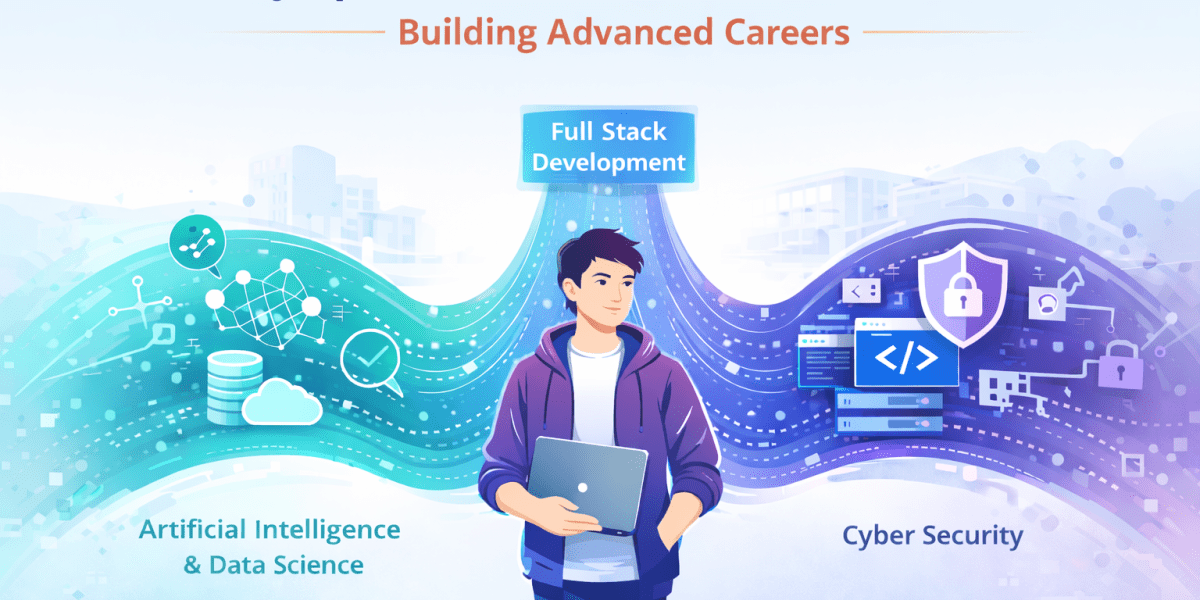
When students and parents think about MCA program, they no longer look at it as a checkbox on resume. They want to see it as a clear path to a career in a fast-evolving tech landscape. Today, roles in Artificial Intelligence, Full Stack Development, and Cyber Security need depth, focus, and technical grit to tackle everyday challenges.
MCA specialization is a changemaker here. It allows students to build deep expertise in one area while still standing on a strong foundation of core computer science. At Lachoo Memorial College of Science & Technology, an AICTE approved institution , the MCA program has been framed such that students can master the specific domain they are passionate about.
From Foundation to Focus: How the MCA is Structured
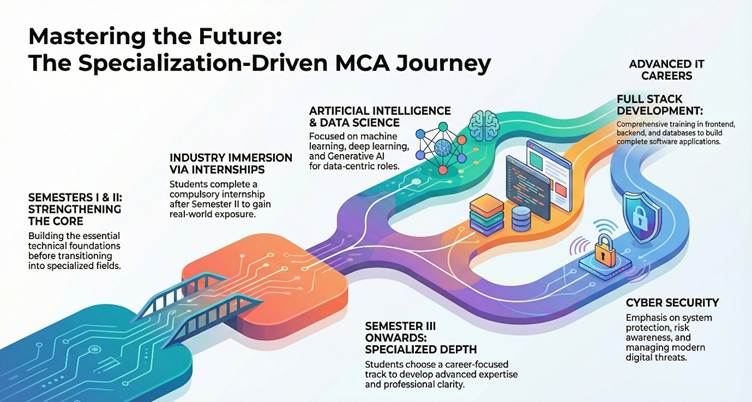
The MCA at Lachoo is designed in key phases. In the first year (Semesters I and II), the students get back to basics and strengthen the foundations. The first year focuses on understanding of programming, data structures, databases, operating systems, computer networks, and essential mathematical concepts which in turn brings learners from diverse backgrounds to a confident and clear deep dive.
After Semester II, the program requires a compulsory internship which are facilitated with regional IT firms and startups. It gives them their first structured exposure to the professional world. During this internship, students get a realistic sense of how software teams function, what kind of roles exist, and where their own interests truly lie.
From Semester III onwards, curriculum allows to choose a specialization aligned with their strengths and career aspirations. This approach is aligned with the National Education Policy (NEP) 20201, which encourages flexible, choice-based learning and a stronger connection between education, skills, and employability.
The three specialization tracks offered are
• Artificial Intelligence & Data Science
• Full Stack Development
• Cyber Security
Artificial Intelligence & Data Science: Turning Data into Decisions
We constantly hear terms like AI, machine learning, and data science in news, industry talks, and even daily apps that we use. Behind all of this are professionals who can understand data, build models, and translate patterns into decisions. The Artificial Intelligence & Data Science specialization is built for students who want to uncover this magic.
In this track, students move beyond simple statistics or textbook algorithms. They work on:
•Data analysis and visualization: understanding raw data, cleaning it, and making sense of it.
•Machine learning: building models that can classify, predict, and recommend.
•Deep learning and neural networks: exploring how systems can recognize images, text, and patterns at scale.
•Generative AI: gaining exposure to modern tools and models that can generate text, images, and more.
This path is ideal for students who enjoy data, patterns, and experimentation. It leads to roles such as Data Analyst, Machine Learning Engineer, AI Engineer, or Business Intelligence Professional—areas repeatedly identified as high-growth in national and international reports.2,3
Full Stack Development: Building Real Applications End-to-End
Every digital service that students and parents use daily—learning portals, banking apps, hospital systems, e-commerce sites—has full stack teams behind it. Full stack developers are the professionals who understand how the user interface, business logic, and database all work together seamlessly.
In the Full Stack Development specialization, students learn to build complete applications step by step:
•Frontend development: designing and implementing user interfaces that are smooth,quick and easy for everyone to use.
•Backend logic: writing APIs, implementing business rules, and handling authentication and security.
•Databases: designing schemas, writing queries, and managing data efficiently.
•Integration and deployment: understanding how to host applications, connect services, and maintain them.
This path suits students who enjoy building things that people can use and see. It leads to roles like Software Developer, Application Engineer, Web Developer, and Product Engineer—backbone roles in IT companies, start-ups, and tech-enabled businesses across India and beyond.
Cyber Security: Safeguarding the Digital Infrastructure
As more organizations digitize their operations, the number of cyber threats continues to grow. Data breaches, phishing attacks, ransomware, and system compromises are not just headlines—they are everyday real risks . This creates a strong and rising demand for trained cyber security professionals.
The Cyber Security specialization focuses on helping students think like defenders. They learn:
•The landscape of cyber threats and common vulnerabilities.
•Principles of secure coding, network security, and access control.
•Basics of ethical hacking and penetration testing.
•Incident response and risk management fundamentals.
This path is a natural fit for students who are curious, detail-oriented, and passionate about safety and trust in digital systems. It opens doors to roles such as Security Analyst, SOC Analyst, Security Engineer, or other positions where protecting systems and data is the primary responsibility.
The Industry-Ready Edge: More Than Just Syllabus Completion
At Lachoo Memorial College of Science and Technology, the MCA is designed around application, not just theory. Students regularly work on real projects—building AI models, developing web applications, or designing security solutions—so learning moves beyond exams to practical problem-solving.
The compulsory internship after Semester II gives early industry exposure, helping students understand real tools, workflows, and expectations while shaping their specialization choices.
In the final year, the capstone projects mentored by faculty becomes a professional showcase. By graduation, students have more than a degree—they have hands-on experience and portfolio-ready work that reflects their chosen field.
The idea is to first build strong foundations and then move towards expertise. At Lachoo College, we believe this shift from a general degree to a defined career path is what truly matters for students and parents today. Students graduate as specialized professionals shaped by a structured and purposeful journey. As a result, they enter the job market with a strong profile, practical exposure, and clear direction about their career goals.
References:
1Ministry of Education, Government of India. National Education Policy (NEP) 2020. New Delhi, India. https://www.education.gov.in/sites/upload_files/mhrd/files/NEP_Final_English_0.pdf
2NASSCOM. “Strategic Review”: IT–ITeS Industry in India, sections on emerging technologies, AI, data science, and software roles.
https://nasscom.in/knowledge-center/publications/technology-sector-india-strategic-review-2025
3World Economic Forum. “The Future of Jobs Report” (latest edition): Skills outlook for AI, data, and software development roles.
https://www.weforum.org/publications/the-future-of-jobs-report-2025