
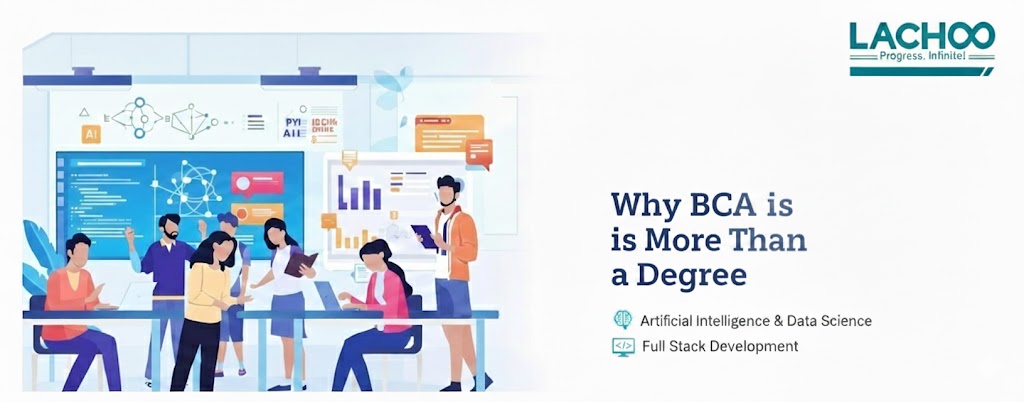
Most students after 12th face the same doubt, will the degree I choose actually prepare me for industry work, or will it only help me pass exams? Choosing BCA is not just about picking the next program after school, instead it is a conscious step into the world of technology, where students begin to see themselves as future professionals.
At Lachoo Memorial College of Science & Technology, the BCA is built to move students beyond the four walls of the classroom through hands-on labs, early specialization, internships, and the PEFS (Professional Excellence & Future Skills) journey that runs alongside regular subjects. The BCA program at Lachoo college is aligned with India’s National Education Policy 2020, which calls for skill-based and holistic learning rather than rote preparation alone (Ministry of Education, 2020)1.
Building Strong Foundations in the Early Semesters
The early semesters of BCA program are built to help students get comfortable with the core building blocks of computer applications. Programming fundamentals, databases, web technologies, and basic problem‑solving skills are introduced in a structured way so that even students from non technical backgrounds can follow along.
Regular labs, project-based learning, guided practice turn theory into something students can actually see and do on a screen. As they move forward, students find that they are no longer writing programs just to clear an exam but begin to recognize how the same concepts are used to design, build, and run real software systems in companies and startups.
PEFS: Learning Beyond the Syllabus
One of the biggest strengths of the BCA program at Lachoo college is that students don’t just study subjects, they grow through PEFS – Professional Excellence & Future Skills – right from the start of their journey.
Through PEFS, students gradually work on their communication, teamwork, professional ethics, problem‑solving, and understanding of how the industry actually functions. Over the semesters, students participate in regular workshops, skill‑building activities, and interactions with professionals. This continuous practice means that by the time they reach higher semesters, they are not just good at coding or theory—they know how to present their ideas, work in teams, and carry themselves with confidence in real workplace settings.
Specialization That Gives Direction
One of the highlights of the BCA program is that, in the later semesters, it offers a clear path into specializations such as Artificial Intelligence & Data Science or Full Stack Development. Industry reports from bodies like NASSCOM and the World Economic Forum consistently point to AI, data science, and full stack development as some of the fastest‑growing, high‑demand areas in tech[2,3], so these are not just academic options—they are career‑shaping decisions.
In the Artificial Intelligence & Data Science specialization, students move past the “how-to” of syntax and learn the “why” of data. They learn to work with real datasets and build foundations of machine learning and deep learning. They are also introduced to mecahnics of Generative AI, understanding how intelligent systems and automation are actually used in real scenarios.
In the Full Stack Development specialization, the focus is on building something from start and seeing it come to life. In this end to end experience, students learn how the fit the pieces together—from the user interface on the front end, to the logic and APIs on the back end, to the databases that store information. This mimics the workflow of actual projects, which companies look for when they hire developers and select interns for real product teams.
Internship After Semester IV: Learning Beyond the Classroom
Another major highlight of the BCA program is the internship after Semester IV, which is closely linked with the goals of PEFS and is also in line with AICTE’s emphasis on mandatory internships and early industry exposure for students4. This gives students a chance to step out of the classroom and into real workplaces, where they can apply what they have learned, observe how teams function, and understand what is expected from them as young professionals.
By the time they reach their final semesters, students are no longer facing their first interview or first project they already have an internship experience to talk about, projects they have contributed to, and a clearer sense of which roles and domains suit them. This sets students apart giving them competitive edge during placements or when they apply for higher studies.
Learning Through Projects and Practical Exposure
Along with PEFS, students participate in vibrant ecosystem of interdisciplinary student led and coding clubs across diverse domains that build practical skills, confidence, and readiness for real industry roles.
When students learn through project-based learning and capstone projects, they are actually doing the kind of work they will be expected to do in real jobs. Working in teams, breaking down complex real‑world problems to manageable solutions, and presenting in front of others helps them naturally build communication, collaboration, and analytical thinking—exactly the kind of skills PEFS keeps reinforcing throughout the program.
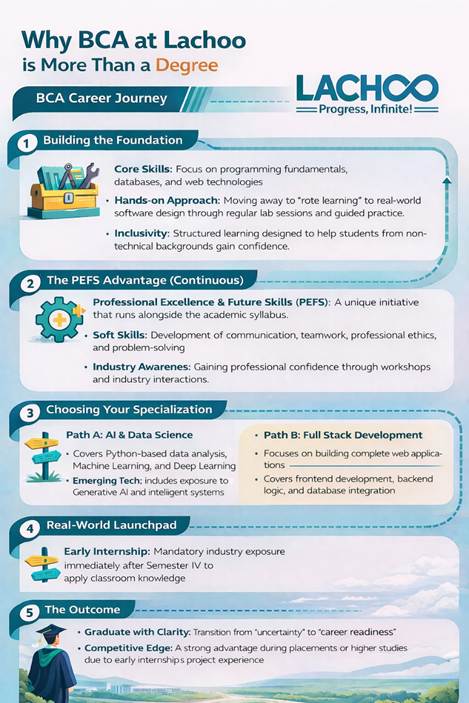
The BCA program is more than collecting marks and a degree; it is a journey to slowly build a future, semester by semester. With specializations, internship and continuous growth through PEFS, students have the confidence and experience to enter a technology‑driven workplace and contribute from day one. Instead of graduating with confusion about “what now?”, BCA students graduate with clear understanding of their strengths, a portfolio of projects, and a realistic sense of the careers they can pursue.
Apply now and take your first step toward a future in AI, Data Science, Full Stack Development, and other emerging technology roles.
1Ministry of Education, Government of India. National Education Policy (NEP) 2020. New Delhi, India. https://www.education.gov.in/sites/upload_files/mhrd/files/NEP_Final_English_0.pdf
2NASSCOM. “Strategic Review”: IT–ITeS Industry in India, sections on emerging technologies, AI, data science, and software roles.
https://nasscom.in/knowledge-center/publications/technology-sector-india-strategic-review-2025
3World Economic Forum. “The Future of Jobs Report” (latest edition): Skills outlook for AI, data, and software development roles.
https://www.weforum.org/publications/the-future-of-jobs-report-2025
4AICTE. “AICTE Internship Policy”: Guidelines on internships and industry exposure for technical and professional programs. https://www.aicte.gov.in/sites/default/files/Aicte%20Internship%20Policy-%2002.04.2019.pdf
Dr. Seema Loonker
Faculty of Computer Science