

Engineering education is much beyond textbooks, curriculum and lectures. It is a journey that nurtures creativity, logical and critical thinking, problem-solving as well as leadership. The Faculty of Engineering offers AICTE approved programs that ensure quality, relevance in today’s evolving times and national recognition. The course prepares students up to the mark so that they can design and implement the concepts for innovation and transforming the world. Faculty of Engineering (FOE) at Lachoo Memorial College of Science and Technology dedicatedly prepare industry-ready graduates having strong knowledge of subject and technology. These future-ready graduates are capable of applying concepts effectively for solving real-world domain specific problems. At Lachoo Memorial College of Science and Technology, Faculty of Engineering (FOE) offers undergraduate programs in:
- Computer Science & Engineering (CSE)
- Artificial Intelligence & Machine Learning (AI & ML)
- Electronics & Communication Engineering (ECE)
All undergraduate engineering programs are AICTE approved, ensuring adherence academic and infrastructure standards.
Computer Science and Engineering (CSE): The program includes theoretical and practical concepts from computer science as well as computer engineering.
Electronics & Communication Engineering (ECE): The program focus on developing and implementing modern communication systems through electronic technologies.
Artificial Intelligence & Machine Learning (AI & ML): AI and ML is a cutting-edge technology. This program helps students to design advanced automated systems by learning though data, and pattern recognition.
The faculty prepares future ready problem solvers through industry-aligned curriculum. These future-ready graduates have strong academic foundation. The founding pillars of core engineering disciplines are advanced laboratories and active technical clubs supported by skilled faculty. Here students are encouraged to convert their ideas into sustainable solutions through repeated coding-based assignments. The programs emphasize on designing concepts and system-level understanding to develop future-ready engineering graduates. Teaching strategies support yearlong industry-aligned learning to solve technological challenges. Subjects like mathematics, and an application-oriented framework ensures that graduates are industry-ready and capable to contribute to technical advancement. The teaching strategy connect student to real-world use cases like automation, IOT, Cyber-Security and industry processes. Activity oriented learning include mini-projects, brainstorm tasks, coding-based assignments, case studies and teamwork exercises.
Computer Science and Engineering (CSE) program focuses on developing strong computational knowledge, analytical ability, and professional skills to meet current and future technical challenges. The program is structured around following focus areas:
- Foundation of Core Computer Science: Programming, data structures, algorithms, operating systems, computer organization, and theoretical foundations to strengthen analytical and problem-solving skills.
- Data Science and Analytics: Database systems, data mining, and data visualization techniques.
- Artificial Intelligence and Machine Learning: AI concepts, machine learning algorithms, deep learning, natural language processing, and computer vision applications.
- Internet of Things (IoT): Development of smart systems using sensors, and embedded programming.
- Professional Skills, Ethics, and Entrepreneurship: Communication skills, teamwork, leadership, and ethical values.
- Research, Innovation, and Learning: Research orientation, industry awareness, and innovative-supported learning model.
Specializations and Career Pathways
- Software Developer /Engineer
- AI/ML Engineer
- Data Scientist
- DevOps Engineer.
- Blockchain Developer
- Game Developer
- UI/UX Designer
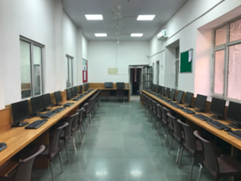
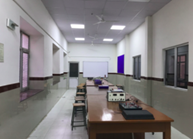
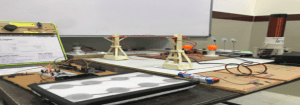
The department is equipped with laboratories for experimental learning in both foundational subjects like engineering physics, electronics, programming etc as well as emerging areas of computer science and engineering like artificial intelligence, machine learning etc. Each lab is equipped with the latest hardware and software which help students to gain practical exposure with their theoretical knowledge. Specialized facilities include Programming Labs, IOT Lab and Networking Lab. In the Programming Lab, students develop, test, and refine their coding abilities across multiple programming languages like C, C++ etc.. The lab provides a structured environment where learners work on software projects, algorithms, and design application. Working with core concepts students transform theoretical knowledge into functional solutions. Through collaborative exercises and coding-based assignments they enhance their problem-solving skill to tackle complex challenges in profession. The IoT (Internet of Things) Lab offers opportunity to explore the world of connected devices, sensors, and smart systems. Learners design, build, and implement IoT solutions by integrating hardware and software components to create intelligent systems. They gain practical experience in sensor interfacing, data acquisition, communication protocols, and real-time analytics. This knowledge helps them to make smart solutions in domain such as smart homes, healthcare, automation, and industrial applications. The Networking Lab provides hands-on platform for students to understand, configure, and manage modern network infrastructures. Students gain practical knowledge of routers, switches, firewalls, and network protocols, with troubleshooting connectivity, performance, and security challenges. Through simulators and collaborative projects, students develop essential skills in network design, and administration. With these skills student is capable to work as professional in IT sector, networking, and communication industry. These shared labs enable students to design, build, test, and validate their solutions using industry-standard tools and platforms and also bridge the gap between classroom and real-world applications. Project-based learning is integrated across all years of the program. Students are engaged in mini-projects, concept-based projects, inter-disciplinary projects, and final-year capstone projects that help them to solve real-world problems and work in domain specific industry.
Engineering graduates are completely prepared to thrive in a variety of technology-focused areas like innovative industries, research and development, higher education, and entrepreneurship. By integrating strong academic foundations with practical sessions, and industry-aligned curriculum, the Faculty of Engineering (FOE) develops creative professionals, effective problem-solvers, and future leaders. Our teaching strategy ensures that students are skilled in the latest technologies and ready to act as ever challenging industry ready professionals.
Dr. Anjali Bohra
Computer Science & Engineering,
Faculty of Engineering.