
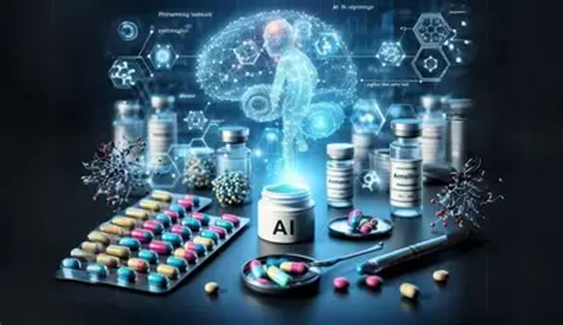
With the integration of Artificial Intelligence (AI), the pharmaceutical industry is undergoing a major transformation. AI means that computers can perform tasks which requires human intelligence such as learning reasoning, problem-solving, and decision-making. In the pharmaceutical sector, AI has drastically changed the scenario of drug discovery, clinical trials, manufacturing, quality control, and patient care by improving efficiency, accuracy, and reducing cost and time.
1. AI in Drug Discovery and Development
Traditional drug discovery is a time taking, expensive, and complex process. AI helps accelerate this process by:
- Identifying potential drug targets using complex data analysis
- Predicting drug–target interactions thereby predicting activity
- Screening large chemical and protein databases quickly
- Designing new drug molecules using machine learning models
Example: AI algorithms can analyze genetic data to identify disease-causing proteins and can suggest suitable compounds.
Benefit: Reduces drug discovery time from years to months and saves a lot of money making healthcare affordable.
2. AI in Preclinical Research
AI helps in predicting:
- Drug toxicity
- Pharmacokinetics i.e ADME profile of the drug.
- Adverse effects or Side effects due to clinical trials of lead molecules.
This helps in elimination of unsuitable drug candidates early, saving resources and improving safety.
3. AI in Clinical Trials
Clinical trials are costly and time-consuming. AI improves clinical trials by:
- Selection of suitable patients through data analysis.
- Prediction of patient response to treatment.
- Optimization of trial design
- Monitoring patient adherence and safety profile.
- It helps in faster trials,reduced adverse drug reactions and better safety of patients.
4. AI in Personalized Medicine
AI enables personalized or precision medicine, where treatment is framed according to an individual’s:
- Genetic makeup
- Lifestyle
- Medical history
AI tools examines patient data to recommend the most effective drug and dosage, therefore minimizing adverse drug reactions.
5. AI in Pharmaceutical Manufacturing
AI is widely used in smart manufacturing to:
- Monitor production processes in real time
- Predict equipment failure (predictive maintenance)
- Optimize batch production
- Reduce wastage and errors
This improves product quality and ensures compliance with regulatory standards.
6. AI in Quality Control and Assurance
AI-based vision systems and data analytics help in:
- Detecting defects in tablets, capsules, and packaging
- Ensuring uniformity in dosage forms
- Monitoring deviations from standard procedures
Advantage: Improved product consistency and regulatory compliance.
7. AI in Pharmacovigilance
Pharmacovigilance involves monitoring drug safety after marketing. AI helps by:
- Detecting adverse drug reactions from large databases
- Analyzing social media and electronic health records
- Identifying safety signals early
This enhances patient safety and regulatory decision-making.
8. AI in Supply Chain Management
AI optimizes the pharmaceutical supply chain by:
- Forecasting demand
- Managing inventory
- Preventing drug shortages
- Reducing logistics costs
Conclusion
Artificial Intelligence is reshaping the pharmaceutical industry by improving innovation, efficiency, and patient outcomes. From drug discovery to pharmacovigilance, AI offers immense potential to address existing challenges. Although there are limitations, continuous advancements and regulatory support will make AI an integral part of the future pharmaceutical ecosystem.
Ruchi Aggarwal
Faculty of Pharmacy